Health Isn’t a Department — It’s a Team Sport
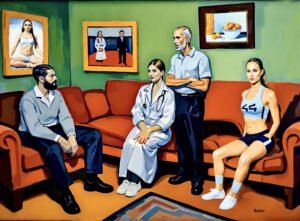
Collaborative Healthcare • Art by Carl Scott Harker
The boundaries that once separated fitness, wellness, and clinical healthcare are dissolving. Not in theory — but in gyms, clinics, telehealth screens, and everyday coaching calls. You may walk into a personal training session and find your movement plan shares notes with your doctor’s orders. Your nutritionist might have your lab results on file. Your physical therapist might co-write a program with your yoga teacher. These connections aren’t gimmicks. They’re signals of a deeper shift: one where siloed services fall away, and your body is treated like one system, not a series of parts.
For people navigating chronic stress, compounding symptoms, or preventative care, this shift isn’t just convenient — it’s necessary. The days of patchwork wellness are numbered. The future favors ecosystems that truly treat the whole person.
Trainers and Clinicians in Sync
There’s a quiet revolution happening in gyms tied to clinics — not glossy partnerships, but real collaboration. Fitness professionals aren’t just building strength plans anymore; they’re helping doctors assess and record activity like a vital sign. When a primary care provider flags inactivity or post-op mobility concerns, the trainer becomes part of the care loop. Not an afterthought — a node. This feedback loop closes the gap between recommendation and action, making patient goals more tangible and data more dynamic.
If you’ve ever tried to follow a vague “get more exercise” prescription, you already know how much it helps to have someone who translates that into reps, sets, pace, and rest. Integration means the workout becomes part of the recovery plan, not adjacent to it.
Coaches as Behavioral Architects
Doctors and nurses can flag the problem. Coaches help people live the solution. That’s not motivational talk — it’s infrastructure. Health coaches serve as the bridge between intention and routine, especially in systems that integrate behavioral health into primary care. They navigate ambivalence, track habits, and decode resistance — often better than any app or spreadsheet. Patients who feel dismissed in clinical environments often find psychological safety with a coach who can slow down and ask different questions. What feels doable today? What’s throwing you off? When clinical directives fall flat, it’s often because they miss the story under the story. Coaches help surface that. Then they stay long enough to help rewrite it.
Bridging with Nurse Practitioners
A surprising but essential connector in this ecosystem is the advanced practice provider — especially family nurse practitioners. Their role increasingly bridges gaps between clinical precision and lifestyle application. Through collaborative care teams, they’re helping patients navigate both medication regimens and movement routines, building rapport across specialties.
In many communities, NPs are the point of continuity, translating diagnoses into sustainable day-to-day changes. A nurse practitioner degree program is designed to equip practitioners for this hybridized world — one where patients need as much coaching as they do clinical oversight. It’s not a luxury. It’s modern care logic.
Trainers Empowering Health
Working out while managing illness used to be a liability. Now, it’s a strategy — when done with care. Personal trainers are being looped into chronic care planning, armed with tools like exercise prescription and community referrals that keep patients moving safely. For example, a diabetic client may work with a trainer who understands insulin timing, foot sensitivity, and energy troughs.
Someone recovering from surgery might rebuild strength under watchful eyes — not through risk, but rhythm. This isn’t “fitness lite.” It’s customized load management. And it’s a key reason many clients stick with training longer when it’s framed as medical momentum rather than just aesthetics. When workouts meet conditions where they live, they turn into something stickier: agency.
Collaboration in Recovery
Once someone enters physical therapy, it can feel like stepping into a new world — one full of diagrams, pain scales, timelines. But recovery doesn’t end when insurance stops covering the sessions. That’s why the next frontier is co-managed aftercare, where trainers and therapists work in sync.
Research shows that year-long collaborative expanded integrative health use leads to better outcomes, especially for complex or chronic issues. A therapist may focus on tissue healing and load tolerance, while a trainer transitions the client into real-life movement — stair climbs, bag lifts, walks with strollers. When these roles overlap with intention, healing doesn’t feel like a temporary project. It becomes part of how someone lives.
Health Coaches as Advocates
Healthcare’s complexity overwhelms even the most organized among us. Now imagine navigating it while sick, under-resourced, or alone. That’s where coaches step in again — not as wellness gurus, but as logistical guides and patient advocates. They help clients ask the right questions, decode treatment plans, and make sense of their options. Their presence supports person-centered, relationship-based care, especially for patients facing systemic barriers.
When someone has an ally who tracks progress and flags concerns before they snowball, their care improves — not just clinically, but emotionally. Coaching here isn’t soft. It’s tactical. It’s what ensures that whole-person care doesn’t just sound nice on paper, but lands where it matters: in the lives being lived.
This shift toward collaboration isn’t hype. It’s already reshaping what it means to care — and be cared for. When trainers, coaches, and nurse practitioners sit at the same table, your health stops being a shuffle between disconnected systems. It starts becoming a conversation. And the more these roles integrate, the more patients stop falling through the cracks. Whether it’s mobility after surgery or motivation after burnout, whole-person ecosystems hold the space for recovery and growth to co-exist. The more we normalize collaboration, the more resilient those systems become. Health doesn’t come from one credential. It comes from care that meets you where you are — and stays long enough to move you forward.
Discover a wealth of health insights and resources by visiting Healthy Human today, and take the first step towards a healthier lifestyle!
News About Health Advocates
Informed Choices
When I was a child my parents
took the family to
Carlsbad Caverns in New Mexico
and there I discovered and learned
of stalactites and stalagmites –
solubles made solid back into rock,
dropping by dropping of mineralized water
falling a few times every hour, over centuries,
forming shimmering, layered stone columns
of strange configurations.
The choices I opt are like those drops
whose results through the days
have producd the man
who writes these words,
and when it comes to health,
I want my choices to be informed,
advised by people I can trust –
about physical exercise,
what I should eat,
maintaining my mental stability,
and how my body works.
So that when I walk through the door
of a coordinated healthcare system,
I come out with the prospect
of a better quality of life and
an expectation of living a little longer
than when I entered.
©2025 Carl Scott Harker, author of

H. M. Woggle-Bug, T.E.
(Highly Magnified Woggle-bug, Thoroughly
Educated) Presents Botanical Surprises
in the Land of Oz
|
|
|
