For hospital supply teams, clinicians, and patient advocates who rely on medical devices to work the same way every time, the hard truth is that tiny manufacturing defects can turn into faulty medical devices at the worst possible moment. Medical device manufacturers face relentless quality control challenges because parts move fast, materials vary, and even minor shifts in assembly can slip past tired human eyes. When that happens, patient safety risks aren’t abstract, they show up as devices that fit poorly, fail early, or behave unpredictably. Clarity starts with understanding how defects are found and prevented before products ever reach care.
Understanding Automated Inspection at a Glance
Automated inspection is how manufacturers use cameras and software to check parts the way a careful reviewer would, only nonstop and at full speed. In practice, computer vision helps spot defects and verify measurements that human eyes may miss. This matters because consistency is the real safety feature in medical devices. People get tired, lighting shifts, and tiny flaws can hide in plain sight. Automated checks reduce “maybe” moments, so patients and clinicians get devices that behave predictably when it counts.
Think of it like airport security screening for products. A trained agent can miss a small detail during a rush, but automated scanners flag the same risk every time. That steady attention is what protects quality across thousands of units. With that foundation, real-time inspection decisions start to depend on fast, on-site computing.
Run Inspection AI On-Site for Faster, Steadier Decisions
Once you understand what automated inspection is doing, the next question is where those AI decisions should happen so the line can keep moving with confidence. Many medical device manufacturers run AI-powered inspection models on powerful on-site servers so they can analyze large volumes of images quickly, in real time, while keeping sensitive production data in-house. That local “edge” approach can make pass/fail decisions steadier on the factory floor, because you’re not waiting on remote processing or sending proprietary images and process details off-site.
A concrete example is the Axial AX300, a high-performance, scalable industrial rackmount edge server with filtered fan engineered for complex workloads in demanding IT and OT environments. With support for Intel Xeon processors, multiple GPUs, and extensive storage and expansion options, it’s built to handle advanced analytics, AI workloads, and virtualization at the edge. Its scalable architecture and built-in security features help organizations deploy powerful on-premise computing right where data is generated, and protections like FIPS security level 1 and 2 compliance, a locking front bezel, and intrusion detection can help safeguard sensitive production data.
Capture? Decide? Act? Learn
Automated inspection works best when it runs on a steady rhythm, not as a one time project. This workflow helps you connect inspection system integration, production line monitoring, and sensor data analysis into repeatable automated quality control steps that keep quality and safety decisions consistent.
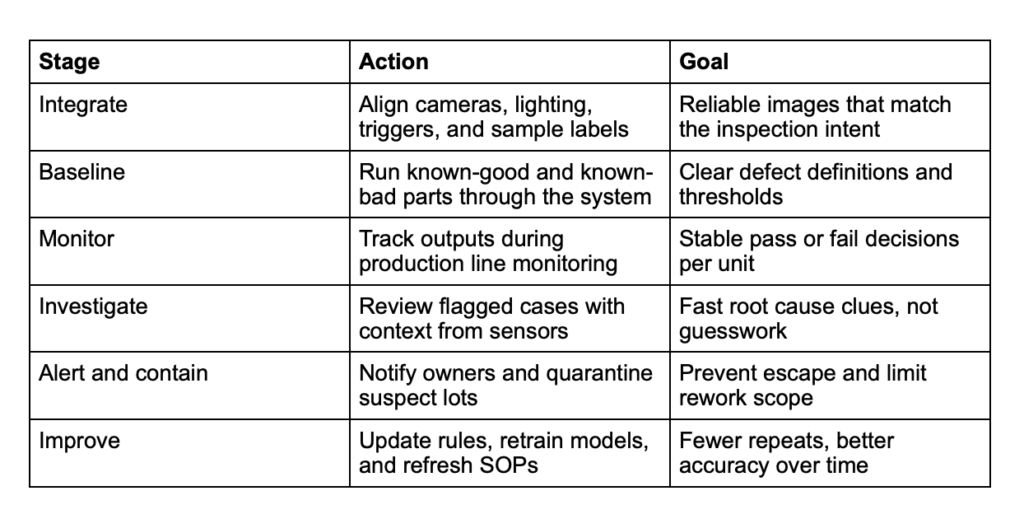
Each stage feeds the next: stronger inputs reduce noise, better investigation improves alerts, and improvements tighten the baseline.
As more teams invest in this loop, the manufacturing data analytics market is growing, and expectations rise with it.
![]()

Monitoring How safe can I be
when AI eyes, through
cameras and other sensory equipment,
scan medical devices
on the assembly line
for faults and defects in quality?
The AI goes through its vast list of checks
at lightening speeds
compared to human eyes that get tired –
as long as the electricity runs
through their circuitry they go on
and on.
Can they spot the unexpected
that is not in the programmed algorithm?
Ah, human judgement still has its purpose,
somewhere along the way, but
how more efficient AI must be
at the end of an 8-hour shift.
I wonder if God is like that
with Its own nearly infinite list
of checks to see if everyone of us –
man, woman and child,
passes the experiences of all the days
and is finally of high enough quality
to return to Its bosom, the vast ocean
of love and mercy – the eternal filler
of the voids within ourselves.
©2026 Carl Scott Harker, publisher of

Western Love Western Magic
by Limon Lamar |
Automated Inspection Q&A You Might Be Wondering
Q: How reliable is automated inspection compared to human checks?
A: It can be very reliable because it applies the same criteria the same way every time, especially for repeatable visual or measurement tasks. The key is treating it as automated quality control with defined thresholds, not a “set it and forget it” tool. Ask to see ongoing calibration results and recent audit logs.
Q: What happens if the system flags good parts by mistake?
A: False positives usually mean more review work, not unsafe devices reaching patients. A smart next step is setting up a quick secondary check lane and tracking the top reasons items get flagged so settings can be tuned.
Q: Can automated inspection miss real defects?
A: It can, which is why teams use validation samples, periodic challenge tests, and trend monitoring to catch drift early. If you’re evaluating a line, request proof of detection performance on the specific defect types that matter most.
Q: How does this support regulatory compliance in manufacturing?
A: Consistent inspection rules plus time-stamped records strengthen traceability and make investigations faster. You can ask how they document requirements, changes, and retraining approvals so quality decisions stay explainable.
Q: What does all of this mean for real patient safety?
A: Better detection and containment reduce the chance that a flawed device ever leaves the factory. The safest programs also tie inspection outcomes to corrective actions so the same issue is less likely to recur.
Building Patient Trust Through Automated Inspection and Quality Control
When every device must perform flawlessly, the pressure is real: small manufacturing errors can become big safety risks. The steady way forward is a quality-first approach that pairs human expertise with automated inspection benefits to strengthen medical device quality assurance and build trust in quality control. With that mindset, teams catch issues earlier, stay aligned with patient safety standards, and spend less time debating whether a part is “good enough.” Automated inspection turns quality from a hope into a repeatable process.
